
While many women are told by their doctors they need to lose weight, we as a nation are focusing on the wrong metric.
Why Weight Loss is Not the Answer for Women Over 40
Weight loss and fat loss are not the same thing, and promoting weight loss alone without the emphasis on body composition improvements can be dangerous for mental health as well as physical health later in life.
While every media outlet feeds women the message that we need to lose weight, being “less than” does not fix the problem of excess body fat and slowing metabolism, nor does it help us feel powerful.
Losing weight in itself slows the metabolism and could equal loss of water, bone density, and muscle mass, which is detrimental to health and increases risk of mortality and injury. The goal should be losing body fat and this goal should also be aligned with gaining and preserving muscle mass and strength over time. Muscle mass gains will speed up metabolism as muscle is more expensive tissue; making it easier to lose body fat and turning your body into an efficient machine.
The focus needs to shift to preserving and gaining muscle mass and strength WHILE decreasing body fat.
What Happens to Metabolism After 40
If you feel like losing weight after 40 is harder than it used to be, you’re not imagining it.
Starting in our late 30s and accelerating through perimenopause and menopause, two things happen simultaneously that make body composition more challenging: estrogen levels drop and muscle mass begins to decline.
Estrogen plays a significant role in how and where the body stores fat. As levels fall, fat that was once distributed in the hips and thighs tends to shift toward the midsection as visceral fat which is the kind that surrounds organs and carries the highest health risks.
At the same time, most women lose 3–8% of their muscle mass per decade after 30, a condition called sarcopenia. This matters enormously for metabolism. Muscle is metabolically active tissue that burns more calories at rest. Less muscle means a slower resting metabolic rate, which means your body burns fewer calories doing the same things it always has.
However, this is not inevitable and it is not irreversible. You are not doomed!
Resistance training is the most effective tool available for preserving and rebuilding muscle mass at any age. When you build muscle, you’re raising your metabolism, improving insulin sensitivity, protecting your bones, and changing your body composition in a way that no amount of cardio alone can replicate.
For women over 40, the goal is not to eat less and move more but to eat enough (especially protein) and lift heavy and consistently over time.
Common Mistakes Women Over 40 Make When Trying to Lose Weight
Relying on cardio alone
Cardio has its place, but steady-state cardio as a primary weight loss strategy for women over 40 can accelerate muscle loss, elevate cortisol, and leave you burning fewer calories over time as your body adapts. Strength training should be the foundation with used cardio as a complement.
Severely restricting calories
Crash dieting triggers your body to protect itself by slowing metabolism and breaking down muscle for fuel. For women already dealing with age-related muscle loss, this accelerates the problem. Eating in a moderate deficit is better than a drastic one, but prioritizing protein is a far more effective long-term strategy.
Not eating enough protein
Protein is the building block of muscle, and most women eat far less than they need. Research consistently shows that higher protein intake supports muscle retention and fat loss. Aim for at least 0.7–1g of protein per pound of bodyweight, adjusted to your activity level.
Using the scale as the only measure of progress
Weight fluctuates daily based on water retention, hormones, food volume, and stress. For women in perimenopause and menopause, hormonal shifts can cause water retention that has nothing to do with fat gain. Relying on scale weight alone leads to discouragement and abandonment of strategies that are actually working. Track strength gains, how clothes fit, energy levels, and sleep quality.
Training like a teenager
What worked in your teens, 20s and even 30s may not be as effective now, depending on what you were doing. Your hormonal environment is different, your recovery needs are different, and your risk factors might be different. Programs built around high-volume cardio, extreme caloric restriction, or rapid weight loss are not designed for the long-term health of women in general, but especially as we age.
The good news: when you stop chasing weight loss and start training for strength, most of these mistakes fix themselves naturally!
Weight Loss vs. Fat Loss
While weight loss is a decrease in the number on the scale, body fat loss is a decrease in body fat, which is the desired outcome most people want.
Body composition includes fat mass and fat free mass. Fat free mass is muscle, bone, water, and organs while fat mass consists of subcutaneous (fat under the skin that insulates the body) and visceral fat (fat that surrounds organs). Though the goal is usually to reduce body fat, some body fat is essential
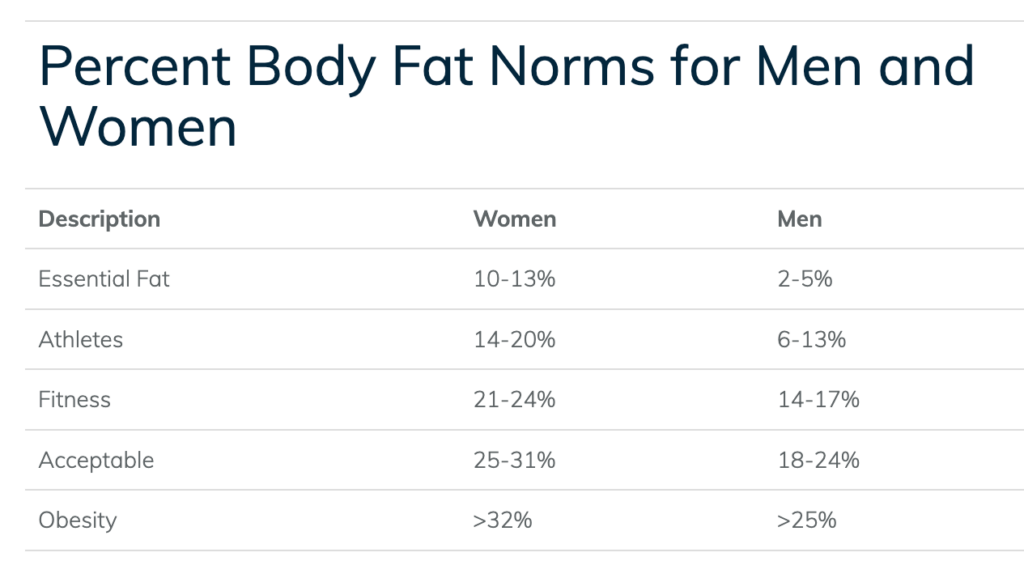
Body composition can be measured through a variety of methods including bioelectrical impedance (not a very reliable or accurate method, but the most accessible), skin caliper measurements, air or water displacement, or dexa scans.
Body Composition Chart Flaws
Keep in mind the chart above tells you what’s “normal,” but doesn’t take into account any individual factors. Some athletes perform better with higher body fat percentages than those listed (specifically in strength or contact sports) and defining body fat as “acceptable” is a potentially harmful term.
If you’re a trainer working with clients or you’re someone who feels that this chart doesn’t accurately represent you, keep in mind that we are all different and have different goals. Seeing this chart and your results alone can be discouraging. Just like the scale, it can be used as a tool, but it should not be used as the ultimate way to determine ideal body composition.
Why We Promote Strength
This is why we tend to promote the benefits of strength training (like living longer, moving better, feeling stronger, being pain-free) versus the goals of body fat percentage. While we appreciate the importance of maintaining a health body composition, we also want women to feel powerful and strong and we believe focusing on the positive changes in confidence, strength gains, and muscle mass increases tend to increase adherence and satisfaction with both a person’s training routine and their body image.
Weight Loss and Mortality
Many studies have shown the benefits of strength gains and the improvements in longevity when resistance training. Now, a new 2022 study has brought to light the disadvantages of focusing on “weight loss” as a goal for health. This study reviewed older women (average age 79), weight loss, grip strength, and mortality.
The findings indicated that grip strength and high scores on physical performance tests (balance, gait speed, chair stand) lowered mortality risk while weight loss was associated with increased mortality. That’s right. Later in life, losing weight increases your risk of death and decreases longevity. This is due to the fact that people (women specifically) lose bone density and muscle mass as they age; and resistance training is the only way to combat these losses.
This study shows the importance for women to focus on strength and mobility training as they age.
Shifting Your Focus From Weight Loss to Strength Gains
While everyone seems to be focused on losing weight, we need to refocus our attention and efforts toward gaining and preserving muscle mass and increasing bone density for later.
Think of resistance training as an investment in your future. Body composition improvements will come with it, but let’s stop glorifying “weight loss” and start focusing on functional improvements and muscle gain (with fat loss as an added side benefit).
Change your mindset, change your life.
If you want to learn more, check out our podcast episode on why weight loss is NOT the answer.
Reach out and book a call if you’d like to work with us. We can help get you back on track!
Resources:
Underland LJ;Schnatz PF;Wild RA;Saquib N;Shadyab AH;Allison M;Banack H;Wassertheil-Smoller S; “The Impact of Weight Change and Measures of Physical Functioning on Mortality.” Journal of the American Geriatrics Society, U.S. National Library of Medicine, https://pubmed.ncbi.nlm.nih.gov/34988972/.
*American Council on Exercise: https://www.acefitness.org/resources/everyone/tools-calculators/percent-body-fat-calculator/